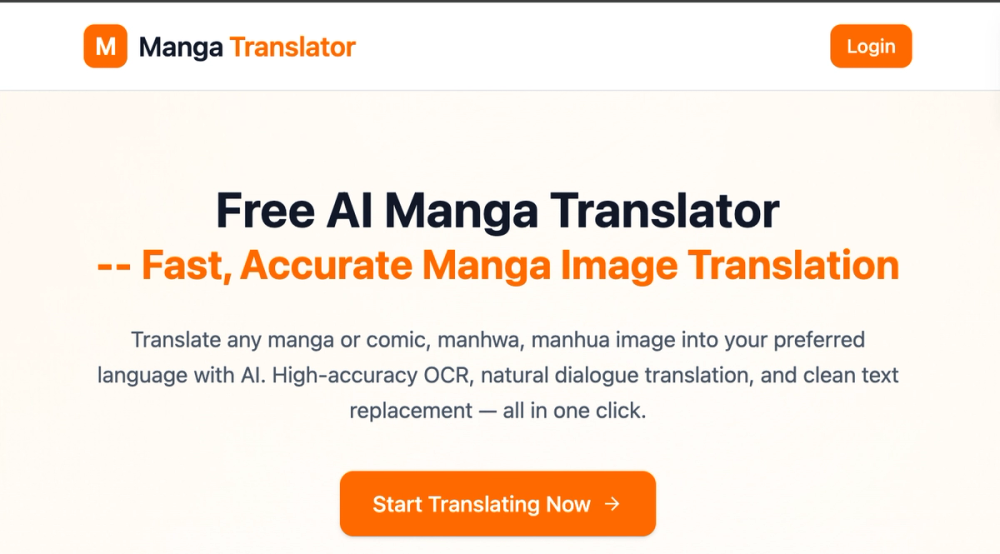
I love reading manga and webtoons, but current tools felt clunky: they require manual language selection, miss text outside speech bubbles, and often degrade image quality when producing localized assets. I wanted a smoother experience — a translator that just works for multi-language comics: it detects language automatically, finds and translates any text on the page (not just bubbles), and produces final images that look great.
What problem were you trying to solve?
We aimed to solve three practical roadblocks that block fast, high-quality manga localization:
Manual language selection — asking users to pick source/target slows everything and causes mistakes.
Partial detection — many tools only read speech bubbles and miss signs, sound effects, or on-background text.
Output quality — translated text often looks pasted; the workflow didn’t support quality tasks like upscaling or final compositing.
How did your approach or process evolve while working on this launch?
The product evolved from a simple OCR+translate prototype into a modular pipeline that emphasizes automation and image quality:
Replaced static workflows with automatic language detection, so users no longer pick source language — the system chooses the best OCR/translation stack automatically.
Built a hybrid OCR layer that detects both bubble and non-bubble text (sound effects, signs, UI in the scene) and feeds everything into the translation pipeline.
Integrated image enhancement and compositing tools so translations are rendered naturally back into panels; the same pipeline supports image upscaling (for cleaner final results).
Iterated on model selection and fallback logic (manga-specialized OCR + multilingual OCR models) to balance speed and accuracy across Japanese, Korean, Chinese, English and more.
Final result: a faster, more accurate, and higher-quality manga localization flow — minimal user input, maximum polish.